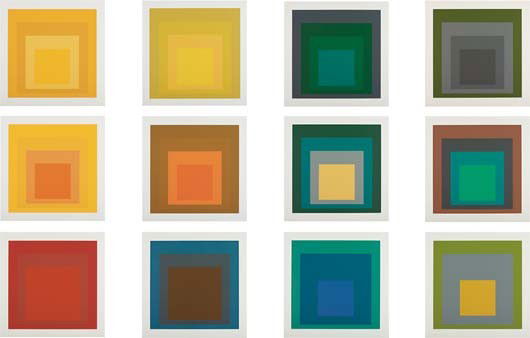
In 1963, Josef Albers released his iconic book –‘Interaction Of Colour’. This was a brave and radical experiment at the time, a new way of looking at and understanding colour. Now, half a century later, this book is just as relevant and important as it was when it was first released. Part of Albers’ belief is that a colour ‘has many faces’, which means that a single colour can appear as two different ones when combined with other colours. This was demonstrated by creating contrasts with paper strips – he split a long piece of brown paper with yellow and blue strip, which then made the brown appear two different shades on separate areas of the strip. Albers has a large emphasis not only on seeing colour, but feeling the relationships between colours too. He uses a visual example called the ‘afterimage effect’, which demonstrates the interaction of colour caused by ‘interdependence of colour’. On the left of the image, there is a white square filled with yellow circles and a black dot in the center. On the right hand side of the image is another white square, but this time with just a black dot in the center. After staring at the left image for 30 seconds, the right hand side of the image appears to be filled with diamond shapes, the ‘leftover’ of the circles. This reversed afterimage illusion is called contrast reversal.

No comments:
Post a Comment